
Understanding your balance system
Your balance system helps you stay upright, keep your eyes steady when you move, and know where your body is in space. It is not just one body part. Good balance depends on your inner ear, eyes, brain, and the feeling from your muscles and joints all working together.
When one part of this system is not working well, you may feel dizzy, off balance, motion sick, lightheaded, or like the room is moving. The balance system has 2 main parts: peripheral and central.

Balance System
Peripheral Balance System
The peripheral balance system is the part of your balance system located outside the brain. It includes the balance organs in your inner ears and the vestibular nerve, which carries balance signals from the inner ear to the brain. These structures sense head movement and head position. When they are not working normally, they can cause dizziness, vertigo, motion sensitivity, or imbalance.
Inner Ear Balance Organs
Inside each inner ear are small balance organs that detect motion and position. These organs constantly send information to the brain about how your head is moving and where it is in space. The brain compares the signals from both ears to help you stay steady. When the signals do not match, you may feel dizzy or off balance.

Inner Ear Balance Organs
Semicircular Canals
The 3 semicircular canals help sense turning movements of the head, like looking left and right, nodding, or tilting. They are filled with fluid, and when your head turns, that fluid shifts and helps signal the direction of movement. This allows your brain to quickly understand that your head is rotating. When this part of the system is affected, people may feel spinning, vertigo, nausea, or symptoms that get worse with head movement.
Utricle and Saccule
The utricle and saccule help sense gravity and straight-line movement. They help your brain know if you are upright, leaning, moving forward, stopping suddenly, or riding in an elevator or car. These organs are important for helping you feel where your head is positioned, even when you are not turning. When they are not working normally, people may feel floating, rocking, pulling, or unsteady when walking.
Vestibular Nerve
The vestibular nerve carries balance signals from the inner ear to the brain. It acts like a messenger, sending information about motion and position so the brain can respond the right way. If that signal becomes weak or uneven, the brain may get mixed messages. This can lead to dizziness, vertigo, imbalance, nausea, and trouble walking.
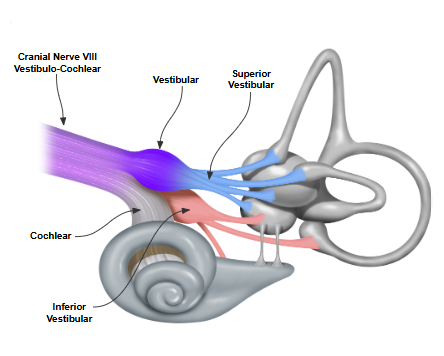
Vestibular nerve, which carries balance messages from the inner ear to the brain
Visual System
Your eyes are a big part of balance. They help your brain understand where you are and whether you are moving. Your balance system also helps keep your vision steady when your head moves, so the world does not seem to bounce or blur. When the visual system and balance system are not working well together, people may feel worse in busy stores, crowds, bright spaces, or places with a lot of movement.
Body Position System
Your muscles, joints, feet, and neck also send important balance information to the brain. This helps your body know where it is without you having to look at it. This system is sometimes called position sense or proprioception. It helps you stay steady when walking, standing, or moving on uneven ground. If this system is affected, balance may feel worse in the dark, on soft surfaces, or when you cannot clearly see where you are stepping.
Central Balance System
The central balance system is the part of the balance system inside the brain. It takes in information from the inner ear, eyes, and body, then sorts it, compares it, and tells your body how to respond. This is how your brain helps you stay upright, move smoothly, and keep your eyes focused when you move.
Brainstem
The brainstem is an important balance relay center. It receives signals from the inner ear, eyes, and body, then helps send out fast responses to keep you balanced and keep your eyes steady. It helps your body react quickly when you move your head or lose your balance. Because it handles so many important signals, problems in this area can sometimes cause dizziness along with other serious neurologic symptoms.

Cerebellum
The cerebellum helps fine-tune movement and balance. It helps your body make smooth, coordinated adjustments so you do not fall when you move. It is especially important for posture, walking, and keeping movement controlled. When the cerebellum is not working well, a person may have trouble walking straight, coordinating movements, or staying steady.

Cerebral Cortex
The cerebral cortex is the outermost layer of the brain. It helps with awareness, attention, and how you make sense of movement and space. It also affects how symptoms feel and how much they interfere with daily life. This is part of why dizziness is not only physical. It can also affect focus, comfort, confidence, and how overwhelming certain environments feel. Busy spaces, motion, or visual overload may feel worse when the brain has trouble making sense of all the signals coming in.

Why Dizziness Can Feel So Different
Different parts of the balance system can create different symptoms.
Problems in the inner ear often cause:
- spinning
- vertigo
- nausea
- motion sensitivity
- imbalance
Problems in the brain may be more likely to cause:
- disorientation
- trouble coordinating movement
- severe imbalance
- dizziness with other neurologic symptoms
Problems in the visual or body position systems may be more likely to cause:
- unsteadiness
- visual motion sensitivity
- feeling worse in busy places
- trouble walking in the dark or on uneven ground
Some people also have more than one part of the balance system involved at the same time. That is one reason dizziness can be complicated.
Key Points to Remember
- Your balance system is a team. The inner ear, vestibular nerve, eyes, muscles and joints, and brain all work together to help you stay steady.
- Dizziness can happen when one part of the system is not working well, or when the brain is having trouble putting the signals together.
- That is why dizziness can feel different from one person to another, and why the right evaluation matters.
